
An LED video processor is a hardware device that acts as a bridge between your video sources (like computers, media servers, or cameras) and your LED wall. It receives, scales, and formats multiple video signals into a single, perfectly mapped image that the LED panels can understand.
What It Does
To ensure an LED screen displays high-quality, continuous video, a video processor handles several critical functions:
- Image Scaling: LED screens often have custom, non-standard resolutions. The processor takes an input (like a 1080p video) and scales or crops it so it maps perfectly pixel-for-pixel onto the LED canvas.
- Signal Conversion & Switching: It converts various inputs (HDMI, SDI, DVI, VGA) into a format the LED wall’s sending cards can interpret. It also allows users to cleanly switch between different video sources, create fade-to-blacks, or cut seamlessly during live events.
- Multi-Window & Layering: Processors allow for picture-in-picture (PiP) displays and can layer multiple sources (like a camera feed and a PowerPoint presentation) simultaneously.
- Image Optimization: They enhance poor-quality signals by performing tasks such as deinterlacing, color correction, and brightness/gamma adjustment so the content looks cohesive across all cabinets.
Processor vs. Controller
While they often work together, processors and controllers serve different purposes:
- Video Processor: The “creative brain.” Handles signal management, switching, layering, and scaling.
- LED Controller (or Sending Card): The “distribution brain.” Takes the output from the video processor and distributes the signal physically to the individual pixels across the LED panels.
-
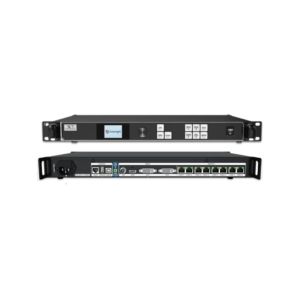 Digital Signage
Colorlight X7
Read moreColorlight X7 2-in-1 Video Processor and LED Controller – Synchronous Mode

-
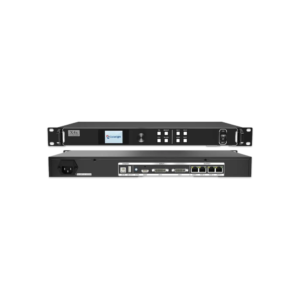 Digital Signage
Colorlight X4S
Read moreColorlight X4s 2-in-1 Video Processor and LED Controller – Synchronous Mode